A blog about Ross Lockwood’s recent talk at University of Alberta Centennial Centre for Interdisciplinary Sciences. Note that much of this is by memory, so apologies to Mr. Lockwood, if I got something wrong.
The photo is from his spincrisis blogsite, link below. There is plenty of good reading there.
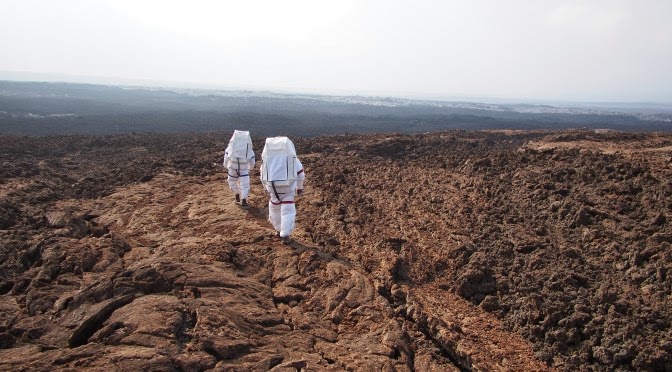
The talk was about a NASA simulated Mars mission (sMARS, as
he put it), on the slopes of a Hawaiian volcano, for 4 months. The idea was to test a crew in a Martian-like
environment – isolated and difficult.
Other projects of this type have been done in other locales, such as the
Canadian Arctic and Russia. The speaker
was Ross Lockwood, a recent PhD grad, who had participated in the mission.
NASA site: http://hi-seas.org
Ross Lockwood’s site: http://spincrisis.com/
About getting the job:
- He thought that his training as an experimental physicist (U of A PhD, just defended recently) was the key reason for NASA selecting him for the crew. Since the crew was to simulate being on Mars, training in practical science, such as an experimentalist receives, would be a very valuable attribute.
- In the NASA interview for the job, he was asked about his “MacGyver Moment” i.e. a time when he had to solve a technical problem with only tools and materials at hand. He told them about driving across the Canadian prairies, when the throttle mechanism of his car began to fail. He jury-rigged it (I can’t recall how) in order to be able to get to the “next town with a Canadian Tire store” (Canadians will understand that reference).
- His scuba experience probably helped too, being used to suiting up and having to bring your own air, I suppose.
- The other thing was persistence. He had applied for this position in an earlier iteration, if I recall correctly.
About the job itself
- There were six crew members, living in a small (1600 square foot?) dome on the slope of Mount Lei in Hawaii. The idea was to simulate the situation of a small crew on Mars, with delayed time communications to Earth, and only their own capabilities to rely upon (though Earth could provide advice).
- Living conditions had to be self-contained in the dome – a small sleeping/private area for each person, and a common area, for example.
- All excursions outside the dome were done in “space suits” – cumbersome hazmat suits that were meant to simulate the suits actual explorers on Mars might use. These were clumsy to get into or out of, and one could not easily do so alone.
- One of the main purposes of the study was to see how a small isolated crew would get on, psychologically, over time. It had been observed that crews in these conditions sometimes withdraw, and become distant from “ground control”, for example. I believe he thought that went on with his crew, to an extent.
- There were 3 males and 3 females in the crew. He didn’t mention how that worked out in any detail, though. I think that aspect might make a great Science Fiction Romance novel or short story.
About the Hawaiian location
- The slope of the Hawaiian volcano was chosen because it was very isolated and the volcanic geology was similar to the volcanic regions of Mars (Tharsis) which would be an interesting region for exploration. The altitude meant it was dry and cold (though not so much as Mars, obviously) and that the air was thin.
- The crew took training in geology and geological field work techniques before embarking on the experiment.
Problems Encountered
- A “Hal 9000 moment” (refers to the SF film 2001) occurred when the power went out one night. Apparently, the batteries were drained, due to a sensor that didn’t work correctly. They had to boost the communications relay with “space suit” batteries. I believe they had to figure that out on their own, as there was no power to communicate with “Earth”.
- The boost worked to re-establish (solar?) power and communications, but the power outage led to ongoing irritating problems. The system wasn’t designed with the expectation of the power ever going totally black.
- A frightening moment for him, involved getting nearly trapped in a lava tube on the side of the volcano.
- Lava tubes are very interesting, because they exist on Mars and would be a ready-made shelter from solar radiation, which would be extremely harmful to explorers on Mars, as Mars doesn’t have a magnetic field to deflect the solar wind, the way that Earth does. Therefore, exploring the Hawaiian lava tubes while suited up was a key mission objective.
- He nearly got stuck in one tube. It narrowed down into a V shape. At the bottom, he could make out something white, which proved to be the remains of a mountain sheep which had become trapped, as the V eventually opened up again, in a sort of hourglass shape.
- He nearly got trapped in the neck of the hourglass, having to haul himself back up to the first level by his arms, his feet not being able to find purchase to help. This was especially difficult to do while suited up. It wasn’t clear whether his crew mates were around to help. He noted that there was a bit of the "fight or flight" reaction involved, triggered by the smell of the dead animal, most likely.
- A small, but significant problem, was the tedium of eating food that had to be rehydrated. Mushy food was definitely monotonous, he said.
Afterwards
- He has done a number of talks about his experience, including the one that he did for us. There has been quite a bit of interest (he is also a good speaker, which helps).
- He thinks an actual flight to Mars is still a long way off. He thinks the internet “Mars 1” project is not really serious and would never work. The private ambitions such as Elon Musk’s “SpaceX” have better prospects, but ultimately a NASA mission is most likely. That would probably be in collaboration with other world space agencies. Maybe it could happen by the 2030’s or 2040’s.
- He will defend his thesis soon. He is currently working on some systems projects at the U of A.


