
Coryn was at the controls
of the flyer when he and Jaime touched down on the dusty ground beside the
large stone pile which was Ferhil Stones.
The sun had set a short
while ago, and the full moon Lina had been rising in the opposite quarter of
the sky from the sunset, while they had travelled across the countryside.
Jaime had stared at it, shaking his head, every
now and then.
“What’s wrong?” Coryn had
asked him, when he had first noticed the gesture.
“That moon is all wrong,”
Jaime had replied. “I did read about it
when I was researching Kordea, but seeing it is a bit different from knowing
that it exists. That moon should not be the
way it is, where it is, so consistently.”
“Consistent is about the
right description for it,” Coryn had said, glancing at the offending night
light. “It does that every night. Comes up directly across from where the sun
sets, when the sun sets, crosses the sky, and then goes down as the sun rises. And always full, so it’s handy, if
anything. I was raised on Space Stations
so I’ve really no concept of how moons ought to behave.”
“It must be at the L2 point
of the sun-planet system,” Jaime had said.
From The
Witches’ Stones Book 2: Love and Intrigue under the Seven Moons of Kordea.
Jaime explains the L2 point to Coryn, in the book, but
here is a more comprehensive explanation of the L2 point, the moon Lina, Kordea’s
sun and their complicated interrelationships.
The L2 point is the second Lagrange point, where the
gravitational field of the sun and the planet, as well as the point’s
centripetal acceleration interact in such a way that it is a gravitationally
stable spot. In other words, an object located
at this spot will tend to remain at this spot.
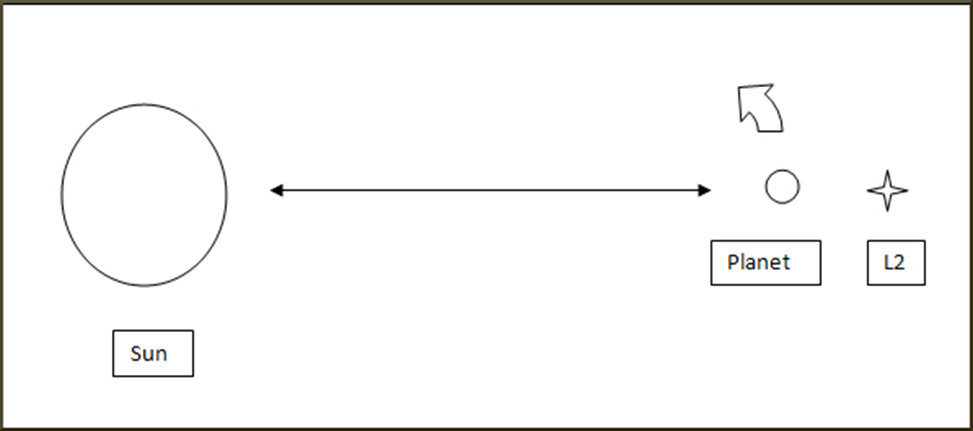
One can think of this as being like the top of a
symmetrical hill, where the gravitational forces from each direction cancel out
and the object therefore is not pulled down the hill. Although the top of a hill is technically a
stable point, as we all know, it isn’t easy to balance something at the top of
a hill, so in practice some energy must be put into “station keeping”.
In the case of the Sun-Earth system, the L2 point is about
1.5 million km from the Earth, a considerably farther distance than the moon,
at about 384 thousand km. The Sun-Earth-L2 system will be collinear (in
a straight line), within the plane of the Earth’s orbit around the sun.
The nice thing about L2 is that an object placed there
will follow the Earth in its orbit around the sun, always staying in the same
relative place, with the Earth directly between it and the Sun. Normally, an object 1.15 million km farther out
than the Earth’s orbit would move a bit more slowly than the Earth, as orbiting
bodies move more slowly as they get farther from the center of the system, and
would lag behind the Earth. But that’s
not the case for a small object in the L2 point. It will seem to follow the Earth in its journey
around the sun, staying in the same relative spot.
It’s a good spot for satellites - in fact, the
replacement for the Hubble Space Telescope, the James Webb is going to use the
L2 point.
In the case of the planet Kordea, the moon Lina is said
to be in the sky all night, anywhere on the planet where it happens to be
night. The natural place for this to be
would be the L2 point for that system. A
moon at L2 would be seen rising as the sun was setting, on the other side of
the sky. It would continue to rise as
the night went on, being highest at midnight, then it would set at dawn, as the
sun rises, again on the other side of the sky from the sun. It would be in a sort of anti-sun position,
so whatever the sun did, the moon Lina would do the opposite.
Assuming that Kordea had a tilt similar to the Earth’s,
in the Northern Hemisphere summer the moon Lina would rise in the southeast and
set in the southwest, similar to what the sun would do in the winter. In the winter, Lina would rise in the
northeast and set in the southwest, like the sun does in summer. At the equinoxes, it would rise due east and
set due west, as does the sun.
So, the Sun-Kordea-Lina system would always have a
luminous body in the sky, day or night.
That would be useful on a planet with a sun hotter than our’s, as it
would allow human activity to go on during the night, similar to how a full
moon allows farmers to harvest through the night in the fall.
The actual distance to the L2 point can be calculated
from the masses of the star and the planet involved. The calculation assumes that the mass of the
body at the L2 point is negligible, compared to the other two masses. The formula is:
L2 dist
= Star to planet distance X cube root of (planet mass/(3 X star mass)).
Kordea is supposed to be substantially hotter than Earth,
so let’s assume the star is bigger and therefore hotter. We will say that it is 1.2 times the mass of
our sun, Kordea is about the same mass as the Earth, and the distance between
Kordea and its sun is about the same as the Earth-Sol distance. Plugging in those figures gives us a distance
to the L2 point of about 1.4 million km.
If Lina was about the same size as our moon (which is
big, as moons go), then at 1.4 million km it would only subtend about one quarter
the angle our full moon does. That gives
only one sixteenth of the brightness of the full moon, all else being equal.
But all else is not equal. For one thing, the luminosity of a star
varies with its mass:
Luminosity = Mass of star to the 3.8 power
(approximately)
If we take 1.2 to the 3.8 power, we get almost exactly
2. So, Kordea’s sun would be twice as
luminous as ours. That would also
increase the star’s temperature (stellar mass and temperature are related), and
move the peak of the radiation towards the blue end of the spectrum
(temperature and the peak of the radiation are related), and would mean more
high energy ultra-violet light. Thus, it would make sense for the inhabitants
of the planet to avoid the bright sun - not only is it hotter, but it emits
more radiation in the dangerous ultra-violet part of the spectrum (which leads
to sunburns and skin cancer on Earth).
Kordea would be a lot closer to the hot edge of its star’s habitable
zone than the Earth is in the solar system.
Also, our moon has quite a low reflectivity or albedo,
only about 0.12 (12% of the light
falling on it is reflected). We can
assume that the albedo of Lina is much higher, say 0.8. Then, when we combine the higher albedo of
Lina, the higher luminosity of Kordea’s star, and the distance to the L2 point,
it turns out that Lina’s brightness would be almost the same as our full moon.
As noted earlier, two issues arise with putting a “moon”
at the L2 point:
- It only works if the mass of that moon is negligible compared to the mass of the star and planet. Our moon is less than 1% of the Earth’s mass, but that’s probably still way too big to be considered negligible. Thus, Jaime considers there must be something very odd about Lina - it must either be hollow, or most of its mass must somehow be gravitationally shielded from the Kordean system. Either way, it strongly suggests that it is not a natural body.
- A body at the L2 point is at a stable point, but one from which a small nudge will knock it out of place, the way a small nudge would knock a round boulder down a big hill, if it was balanced at the top. So, something must be done to ensure that it stays in place, or keeps its station, in satellite jargon. That is the job of the Kordean witches, of course (perhaps with some extra-dimensional help?).


