Friday, 21 April 2023

Visiting the Cypress Hills of Alberta and Saskatchewan

 Visiting the Cypress Hills of Alberta and Saskatchewan

The Cypress Hills are located in southeastern Alberta and southwestern Saskatchewan. The two provinces share an inter-provincial park, which feature this landscape. The parks are located in the central areas of the Cypress Hills, but the geographical area itself extends quite a bit farther than the park boundaries. The parks are about 30 miles east-west and about 10 miles north-south. The higher elevation area is probably more like 100 miles by 30 miles, depending on how you define “higher elevation”.
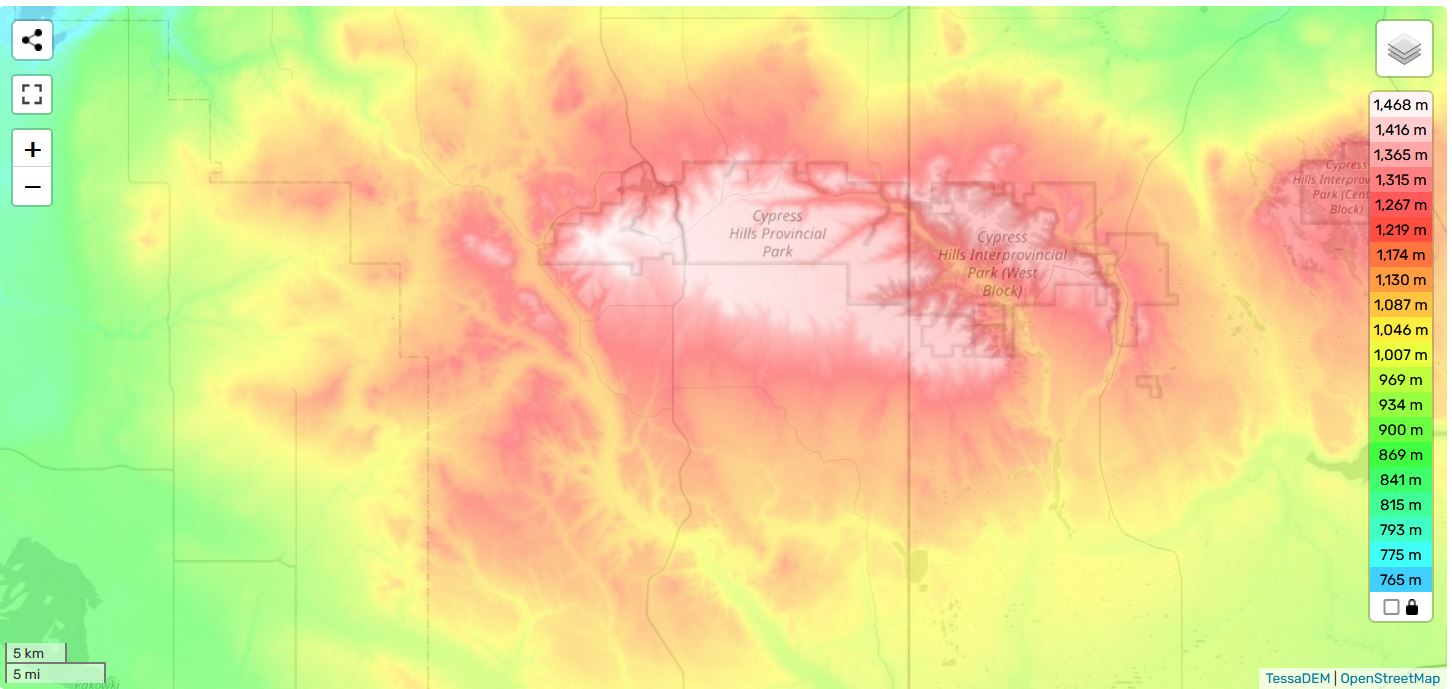

The hills are a geological and geographical oddity, as they arise rather suddenly from the mostly tabletop prairie that surrounds them. They are fairly extensive in area, so not just a small anomaly. At their highest peak, they rise to 4810 feet on the Alberta side and 4567 feet on the Saskatchewan side. The surrounding prairie tends to be at around 2000 to 2500 feet or so, so that’s a fairly substantial increase in elevation.

A plaque in the park calls the Cypress Hills “an island in the ice”. This refers to the fact that the area’s height saved it from being covered by the massive sheets of ice that blanketed much of the northern half of North America in the recent past (recent by geological standard, some 10,000 or so years ago).

As with any island, that created a habitat for plants and animals that is quite different from the surrounding area. In fact, the flora and fauna tends to be quite similar to that found in the more mountainous areas to the southwest, in Montana and Wyoming. For animals, that includes a lot of smaller animals (rodents, rabbits, skunks, weasels, foxes, lynx) as well as some larger mammals (elk, deer, pronghorn, coyotes, cougars). As an example, attached is a picture of a deer that was keeping watch on us, during our hike through the trees.


As for plants, the dominant trees are aspen, lodgepole pine, and white spruce. The grasslands are mixed-grass prairie and fescue prairie in higher elevations. There is an abundance of wild flowers. Elkwater Lake, which is within the park boundary has many species of fish, including walleye, perch, pike and trout.

There is a small town in the park, Elkwater, which caters to park visitors. There are some hotels and cabins for rent, some restaurants, pubs and other shopping opportunities. The town is on the shore of Elkwater Lake, which is used for various recreational activities. My traveling companion and I rented one of these cabins for a couple of nights. It was pleasant and a bit quaint. It had a shower. That’s always nice. We used it as a base camp for exploration for a couple of days, then tented it for a night in one of the rather nice campgrounds farther into the interior of the park. Our explorations involved some driving, some hiking, some sight-seeing and a visit to a historical recreation of a former Northwest Mounted Police fort.


On the first day, we drove the loop from Elkwater eastward along Reesor Lake Road, then south along Battle Creek Road and back west along Graburn Road. This is all in the Alberta side of the park. That took about one morning, what with various stops along the roadways to check out the viewpoints and the plaques and do a bit of hiking. Driving in a counter-clockwise direction from Elkwater, here are some of the features along the way:

  • The Reesor Viewpoint, along Reesor Lake Road. A nice little spot with great views of the valley and river beyond. There is a picnic table and a plaque about the aforementioned “island in the ice”.

  • Police Point Slump (and plaque), along Battle Creek Road. In 1967 there was an enormous “slump” (a sort of landslide) of rock and soil at this point. A rapid snow-melt in the spring of that year caused a lot of seepage into the pore spaces of the conglomerate rock below (a sort of natural concrete). The base of the hills was composed of bentonite clay (very slippery, used in oil drilling) so the weight of the waterlogged soil and bedrock was too much, and thus a sudden slump of several million cubic meters of earth was the result. A lot of the vegetation has grown back since then, but there is still evidence of the slump today, though it was a lot less dramatic than in the past, at least to my eyes. There is apparently a biking/hiking trail along the ridge, which probably gives better views than the roadside pullout does. 


  • The Graburn Overlook, along Battle Creek Road. This is a pretty little spot with another plaque. It points out that this is one of those “continental divide” locations, where water in one creek flows south and eventually joins up with the Mississippi River system, thus flowing to the Gulf of Mexico, while water from a nearby creek will flow north and eventually end up in Hudson’s Bay. During the 1930s the “flats” hosted a picnic and rodeo, which attracted people from all around. The name Battle Creek is a reference to an event that occurred somewhat downstream, known as the Battle Creek Massacre (more on that later).


  • The Graburn Cairn, at the start of Graburn Road. This is a cairn that was put up quite some time ago, by the looks of it, by the Province of Alberta. It commemorates a NWMP constable named Marmaduke Graburn, who was shot and killed in the Cypress Hills in 1879. He was the first officer to be killed by violence (as opposed to an accident or similar misadventure) after the force was constituted in 1873. A Blood Indian by the name of Star Child was accused of the murder but was found not guilty in 1881. Apparently, he and Graburn had been seen having an argument earlier in the day that the officer was killed, but the jury found that too weak a case to convict. There is also a large roadside marker on the Trans-Canada Highway that commemorates this officer. He was just 19 and his main duties involved looking after some of the horses that the force used (it was, after all, the Northwest Mounted Police).

  • The Survival Tree, along Graburn Road. This plaque and lookout is devoted to a very old tree, a lodgepole pine that has become celebrated as “The Survival Tree”. According to the plaque, it has endured “wind... heavy snows and... summer drought” as well as “mauling by cattle”. It is over 125 years old, as it was known to have been cut down in 1900, but has regrown since then. It’s kind of gnarly and not too tall, but it’s a fighter. So, make like my hiking partner and give it a three cheers.


  • Bull Trail. This gravel road intersects the loop in a couple of spots. And, yes, there were cattle on the road, though we didn’t check to see if any of them were bulls.

I should note that you can take Bull Trail south to a road that’s outside of the park boundary (Fox Road, which turns into Township Road 24) and loop back to Highway 41 or some other local roads. Alternatively, you can go north on Bull Trail, to get to a campground and small lake (Spruce Coulee).


 After having lunch in town we headed out to Horseshoe Canyon lookout, for a short hike (about an hour), took the view and got some pictures. A friendly stranger offered to take some photos of us, which we appreciated. It was a hot day, and some of us were looking pretty scruffy by then. After that, we went back to town to wander around the lakeside for a while and just relax. But, like MacArthur in the Philippines, we said “we shall return”.


 Which we did, the next day, for a longer looping hike along the Old Baldy and Horseshoe Canyon trail, up to Horseshoe Canyon, then back through the Beaver Creek trail, which went through the forest along Beaver Creek. Lake Elkwater is at 1230 meters elevation and Horseshoe Canyon is at 1450 meters, so it is a climb of about 220 meters (about 730 feet), and the trails involved come to about 5 km in length. So, that’s an average grade of about 5%, which is a pretty good workout. That said, a lot of the walking is along flat stretches, especially the hike along Beaver Creek.


There was quite a profusion of wild flowers to be seen, several lookouts with spectacular views and some sections with stands of tall trees. My hiking partner spent some time corresponding with a curious squirrel and we also saw some deer along the way, through the trees. 


That hike took most of the afternoon. We then struck out for a campground, to spend at least on night in our tents. I believe it was the Spruce Coulee campground, though it might have been a different one. Regardless, it was a fairly big “car camping” campground with plenty of campers. It was quite well supplied with the usual amenities – pit toilets, water, firewood, etc.. I vaguely remember a shower, but I can’t be sure of that. It was fairly quiet for a well-attended camp.

The next day we headed for the Saskatchewan side of the park. The weather had been quite dry, so the roads within the park were very good. 


 The Saskatchewan side of the park has fewer campgrounds and view points, but it does have a few very notable attractions. One of these is the Conglomerate Cliffs, which are reached by continuing along the Battle Creek Road east, then taking Ranger Station Road and Conglomerate Cliffs Road. Eventually you arrive at a rather spectacular viewpoint, which looks across the hills, to the badlands across the river and the prairies in the far distance.

The unique feature of the Conglomerate Cliffs is, of course, the conglomerates. As noted previously, this is a type of rock that is often referred to as “natural concrete”, whereby gravel is intermixed in a matrix of sand and cement, usually of calcite or quartz, which binds the rock together. So, it does rather resemble the concrete you might use for a sidewalk. In these cliffs the “clasts” (cobbles or just plain rocks in more common parlance) are generally of a light brown hue, made from eroded sedimentary rock such as sandstone. The hard conglomerate capstone is relatively resistant to erosion, so the cliffs can be somewhat undercut, and jut out from the underlying rock formations. As you can see in the photo, this can result in some unusual looking cliffs, and it’s a fair ways down, so one is advised to be careful while scrambling about.


After spending some time at these cliffs, we headed to the other notable attraction, nearby Fort Walsh, a historical reconstruction of an early Northwest Mounted Police fort.

Fort Walsh was built in the early days of the NWMP. In June 1873 there was an armed conflict between American “wolf hunters” and the native Nakoda people, at a site just south of Fort Walsh. This has become known as the Cypress Hills Massacre, as many natives were killed. That pushed the new Canadian federal government (Canada was constituted in 1867) into creating a police force to enforce the law in the Canadian prairies. By June 1875 Fort Walsh had been constructed and manned by the Mounties.


 By way of background, the fur trade was still a going concern through most of the region, but unscrupulous traders, mainly but not exclusively from the U.S., were including liquor (often cut with even more unhealthy substances) among the trade goods, which was causing great distress to the natives, who had little experience with the stuff. That was one of the primary reasons that the Mounties were created, though patrolling the border was also important, as was bringing Canadian law to the unregulated west, in general. Events in the U.S., particularly the Battle of the Little Big Horn, also had their repercussions in Canada, including the migration of some of the natives involved in that conflict. So, Fort Walsh and its personnel became involved in negotiations among American authorities and the Lakota.

So, Fort Walsh was an important outpost in the early days of Canada’s development of the west. The reconstructed fort and native encampment, along with the historical actors employed there, are set in that era. The fort is supplied with goods and equipment that fit the times, as are the employees, who are dressed as Mounties or support staff who might have been employed at the time. That equipment includes a cannon (maybe two), though I can't recall for sure.  There are some occasions when the cannons are fired, with charges but no projectile, but this was not one of those days.

The actors discuss “their” lives, at they would have lived them at the time. That would include what they ate, where they slept, how they maintained horses, what weapons they had, what they did in their off-hours and so on. This proved to be very interesting.

On a personal note, one of the items that was on display was a “crokinole board”. This was a sort of shuffleboard or curling game, reduced to tabletop dimensions. Rather than slide a rock down the ice, the player flicks a disk towards a series of concentric rings, rather like a curling rink. In my youth, one of my friends had such a board, and we all played this game quite often. It was interesting to see that it extended back that far in time. Wiki says printed references to the game in Canada go back to 1867, while the earliest American references were from 1880. Obviously, though, it must have been invented before these references. At any rate, it was an amusing walk down memory lane for myself and my hiking partner.


With that, we had to wrap up our short but interesting trip to the Cypress Hills and head back on the long drive to Edmonton.


And here are some travel accounts that you might like, on Amazon. 

===========================================================

On the Road with Bronco Billy


Sit back and go on a ten day trucking trip in a big rig, through western North America, from Alberta to Texas, and back again. Explore the countryside, learn some trucking lingo, and observe the shifting cultural norms across this great continent.

Amazon U.S.: http://www.amazon.com/gp/product/B00X2IRHSK

Amazon U.K.: http://www.amazon.co.uk/gp/product/B00X2IRHSK

Amazon Germany: http://www.amazon.de/gp/product/B00X2IRHSK

Amazon Canada: http://www.amazon.ca/gp/product/B00X2IRHSK


=======================================================

What follows is an account of a ten day journey through western North America during a working trip, delivering lumber from Edmonton Alberta to Dallas Texas, and returning with oilfield equipment. The writer had the opportunity to accompany a friend who is a professional truck driver, which he eagerly accepted. He works as a statistician for the University of Alberta, and therefore is generally confined to desk, chair, and computer. The chance to see the world from the cab of a truck, and be immersed in the truck driving culture was intriguing. In early May 1997 they hit the road.

Some time has passed since this journal was written and many things have changed since the late 1990’s. That renders the journey as not just a geographical one, but also a historical account, which I think only increases its interest.

We were fortunate to have an eventful trip - a mechanical breakdown, a near miss from a tornado, and a large-scale flood were among these events. But even without these turns of fate, the drama of the landscape, the close-up view of the trucking lifestyle, and the opportunity to observe the cultural habits of a wide swath of western North America would have been sufficient to fill up an interesting journal.

The travelogue is about 20,000 words, about 60 to 90 minutes of reading, at typical reading speeds.

==========================================

Driving North - On the Road to Northern Alberta and the Northwest Territories: A Driving Journal


Have you ever wondered about a road trip to the far north, north of the Sixtieth Parallel? Well, here is your chance to read about three road trips, through the Peace River country and the northern Rockies, all the way to the shores of Great Slave Lake, just south of the Arctic Circle.

Just $1.99 on Amazon, or free if you have Kindle Unlimited.


Amazon U.S.: https://www.amazon.com/dp/B074LZDQ9F

Amazon U.K: https://www.amazon.co.uk/dp/B074LZDQ9F

Amazon CA: https://www.amazon.ca/dp/B074LZDQ9F

Amazon Germany: https://www.amazon.de/dp/B074LZDQ9F

Amazon Japan: https://www.amazon.co.jp/dp/B074LZDQ9F

Amazon India: https://www.amazon.in/dp/B074LZDQ9F

Amazon Australia: https://www.amazon.com.au/dp/B074LZDQ9F


The highways in northern Alberta and the Northwest Territories give one the opportunity to drive pretty far north, without a lot of elaborate preparations and extreme expense. Starting from Edmonton, one can drive as far north as Yellowknife, NWT, without leaving the hardtop, so an average vehicle can do the trip. There are a reasonable number of fair sized towns along the way, so accommodations are not much of a problem, either. The same goes for food, gasoline and other essentials.

One can also link up with the Alaska Highway, and the Dempster Highway, and make it all the way to the Arctic Ocean. But that’s another story.

Trip number 1 involved driving north through Alberta, visiting several areas of interest along the way, then into the Northwest Territories, to Hay River on the southern shore of Great Slave Lake. The return trip featured a drive through the north-central foothills of the Rocky Mountains.

Trip number 2 was a combined air and car trip. We went to Yellowknife, Northwest Territories by airplane, then rented a car to explore much of the area of the north shore of Great Slave Lake.

Trip number 3 was a return to Hay River, with a different travelling companion. This allowed one to retrace steps, compare and contrast, and focus on some areas that we had not had time to explore in depth on trip number 1.


Monday, 27 March 2023

Visiting the Viking Rib Stones

Visiting The Viking Rib Stones (Alberta)

Copyright: Dale Olausen 2023

The Viking Rib Stones are an interesting site from various points of view – ethnographic, archaeological, intercultural, indigenous, call it what you will.

I have visited this site on a number of occasions. It is a nice little half-day trip from Edmonton along some not-too-busy highways, culminating in a short drive through some pretty prairie secondary roads. This site is a little bit tricky to get to, as the province and the aboriginal groups want to maintain the site in a respectful way. However, there are directions available from a web search.

It’s worth the effort, especially if you have out-of-province visitors – I have found that our visitors to Alberta have always enjoyed the trip.

To begin with, I should note that the Viking Rib Stones have nothing to do with Vikings. They just happen to be located near the town of Viking, a community that was settled largely by Scandinavians early in the 20th century.


They are, in fact, an excellent example of native art that is found in many areas of Alberta. Of course they are more than just art – they have significant cultural and spiritual significance for aboriginal people.

In strictly physical terms, they consist of two large rocks ( a large rock and a smaller rock), made of quartzite. They are solitary boulders that were carried to this spot by glaciers during the ice ages, and left behind as the glaciers retreated. The geological term for this is glacial erratic.

Upon this rock many markings have been carved. These carvings are meant to represent the ribs of two buffalo. The location is considered to be the dwelling place of the protector of the buffalo (known as Old Man Buffalo). There are also pits carved into the stones, representing holes left by arrows or bullets. These were not thought to harm the Old Man Buffalo, but rather to pass right through. There is also an interpretation that these pit represent the steady pounding of buffalo hoofs over the ages, rather in the manner that the steady drip of water will wear a pit into stone over time.


People, primarily aboriginal people one assumes, leave various objects of veneration and personal significance on and around the Rib Stones. Metals such as coins or spent bullets are common, as are jewellery and other personal items. But other items are also sometimes left, such as photos, books or tools, whatever might be significant to the leaver. Tobacco is also common, given its historical cultural significance to natives.

The Rib Stones site also has a nearly copse of trees, where aboriginal people have tied strips of cloth to these trees (known as prayer cloths), left as offerings to the spirits of the ancestors. The fencing around the little site might also used for this purpose.

The area surrounding the site, which has a small fence to enclose it, is left in a natural state, with grasses and wildflowers predominating.


A very large meteorite, known in English as the Iron Creek Meteorite, fell around here, at a location about 40 kilometers away, called Strawsack Hill. The configuration of the Rib Stones is thought to be aligned in such a way that it points to this location. It is also thought that some aspects of the meteorite are actually represented in the Rib Stones.

It is about half a meter in diameter, almost entirely composed of iron, and is considered to be a sacred object by the native population, the “father of meteorites”. It is thought to come from the gods or sky-people, a sort of visitor to the Earth, and therefore of great spiritual value. Native culture has a lot of tradition related to the sky and the stars, as might be expected given the big sky of the prairies and the dark nights of eras before electric lighting.

This meteorite rested on a high hill nearby, until the later 1800s when it was taken by missionaries and later claimed by researchers in various locations (including the University of Toronto). It was returned to Alberta in the early 1970s and has spent many decades at the Royal Alberta Museum, in Edmonton. There is a plan to return it to its original location, near this site, though the details are still being negotiated. According to the website of the Royal Alberta Museum there is a centre to be built at the site, so it will still be housed in a building. In that sense, it won’t really be returned to its ancestral state, but I suppose it would be too tempting a prize for all sorts of people if it was just dropped on the prairie.


Besides the Rib Stones, the site itself is very scenic, on a hill that commands a sweeping vista of the surround rolling prairie. There is a small parking lot, some signage, and the fenced in Rib Stones site (a low wooden fence, no gate, more to define the site than keep people out). It goes without saying that visitors should be respectful of the Rib Stones and the site in general.

After viewing the Rib Stones and associated area, one can stop in the nearby town of Viking, that has a homey little cafe and some other small-town tourist amenities (e.g. a Scandinavian "troll park", as Scandinavians have a thing for trolls, though the folklore type, not the internet type).

My dad (from Norway) homesteaded around here (the Iron Creek area) many decades ago, before going off to war and meeting his war bride, so I have a certain affinity for the area. On one trip to the area with my brother, the car window suddenly shattered. At first we thought someone might have been carelessly target shooting out in a field, but upon later reading I discovered that this isn’t that unusual an occurrence (lots of insurance claims are due to unexplained car window shattering). But it is nice to think that this might have been around the same spot as my dad’s homestead. You don’t have to be native to feel some sort of spiritual energy in the landscape.

-------------------------------------------------------------------------------------------

Now, if you like travel-related reading,why not try one of these:

On the Road with Bronco Billy

Spring is on us now, and that brings on thoughts of ROAD TRIP. Sure, it is still a bit early, but you can still start making plans for your next road trip with help of “On the Road with Bronco Billy”. Sit back and go on a ten day trucking trip in a big rig, through western North America, from Alberta to Texas, and back again. Explore the countryside, learn some trucking lingo, and observe the shifting cultural norms across this great continent. Then, come spring, try it out for yourself.


Amazon U.S.: http://www.amazon.com/gp/product/B00X2IRHSK

Amazon U.K.: http://www.amazon.co.uk/gp/product/B00X2IRHSK

Amazon Germany: http://www.amazon.de/gp/product/B00X2IRHSK

Amazon Canada: http://www.amazon.ca/gp/product/B00X2IRHSK


======================================================

A Drive Across Newfoundland


U.S.: https://www.amazon.com/dp/B07NMR9WM8

U.K.: https://www.amazon.co.uk/dp/B07NMR9WM8

Germany: https://www.amazon.de/dp/B07NMR9WM8

Japan: https://www.amazon.co.jp/dp/B07NMR9WM8

Canada: https://www.amazon.ca/dp/B07NMR9WM8

Australia: https://www.amazon.com.au/dp/B07NMR9WM8

India: https://www.amazon.in/dp/B07NMR9WM8

Newfoundland, Canada’s most easterly province, is a region that is both fascinating in its unique culture and amazing in its vistas of stark beauty. The weather is often wild, with coastal regions known for steep cliffs and crashing waves (though tranquil beaches exist too). The inland areas are primarily Precambrian shield, dominated by forests, rivers, rock formations, and abundant wildlife. The province also features some of the Earth’s most remarkable geology, notably The Tablelands, where the mantle rocks of the Earth’s interior have been exposed at the surface, permitting one to explore an almost alien landscape, an opportunity available on only a few scattered regions of the planet.

The city of St. John’s is one of Canada’s most unique urban areas, with a population that maintains many old traditions and cultural aspects of the British Isles. That’s true of the rest of the province, as well, where the people are friendly and inclined to chat amiably with visitors. Plus, they talk with amusing accents and party hard, so what’s not to like?

This account focusses on a two-week road trip in October 2007, from St. John’s in the southeast, to L’Anse aux Meadows in the far northwest, the only known Viking settlement in North America. It also features a day hike visit to The Tablelands, a remarkable and majestic geological feature. Even those who don’t normally consider themselves very interested in geology will find themselves awe-struck by these other-worldly landscapes.

=========================================================

A Ride on the Kettle Valley Rail Trail: A Biking Journal Kindle Edition


by Dale Olausen (Author), Helena Puumala (Editor)

The Kettle Valley Rail Trail is one of the longest and most scenic biking and hiking trails in Canada. It covers a good stretch of the south-central interior of British Columbia, about 600 kilometers of scenic countryside. British Columbia is one of the most beautiful areas of Canada, which is itself a beautiful country, ideal for those who appreciate natural splendour and achievable adventure in the great outdoors.

The trail passes through a great variety of geographical and geological regions, from mountains to valleys, along scenic lakes and rivers, to dry near-desert condition grasslands. It often features towering canyons, spanned by a combination of high trestle bridges and long tunnels, as it passes through wild, unpopulated country. At other times, it remains quite low, in populated valleys, alongside spectacular water features such as beautiful Lake Okanagan, an area that is home to hundreds of vineyards, as well as other civilized comforts.

The trail is a nice test of one’s physical fitness, as well as one’s wits and adaptability, as much of it does travel through true wilderness. The views are spectacular, the wildlife is plentiful and the people are friendly. What more could one ask for?

What follows is a journal of two summers of adventure, biking most of the trail in the late 1990s. It is about 33,000 words in length (2 to 3 hours reading), and contains numerous photographs of the trail. There are also sections containing a brief history of the trail, geology, flora and fauna, and associated information.

After reading this account, you should have a good sense of whether the trail is right for you. If you do decide to ride the trail, it will be an experience you will never forget.

Amazon U.S.: https://www.amazon.com/dp/B01GBG8JE0

Amazon U.K.: https://www.amazon.co.uk/dp/B01GBG8JE0

Amazon Germany: https://www.amazon.de/dp/B01GBG8JE0

Amazon Canada: https://www.amazon.ca/dp/B01GBG8JE0

Amazon Australia: https://www.amazon.com.au/dp/B01GBG8JE0


Monday, 13 March 2023

Pi Day 2023 –Random PI


Pi Day 2023 –Random PI

Using Random Processes to Estimate PI

In the past I have done a few PI Day blogs using Monte Carlo process to estimate PI:

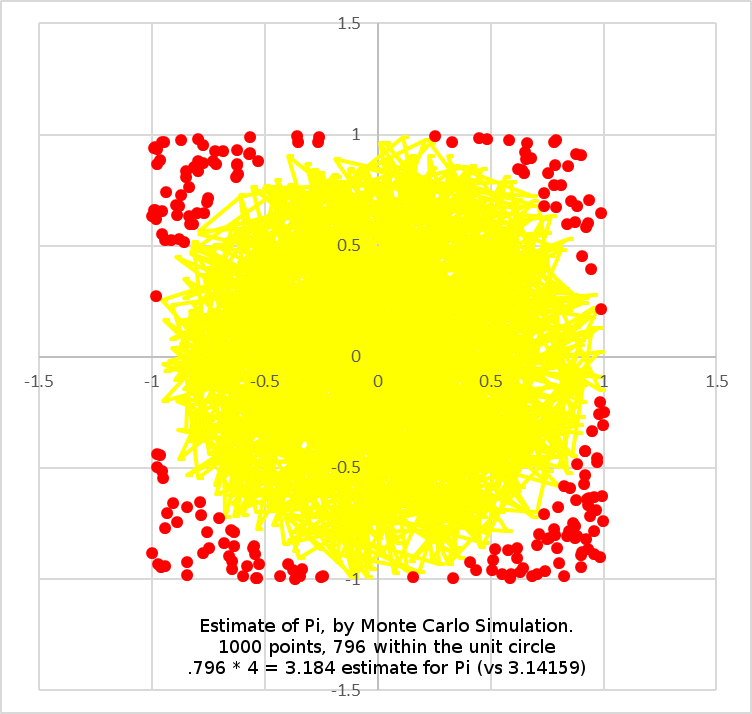
A Monte Carlo simulation makes use of random numbers to simulate some process many, many times, then takes some sort of average result. For example, the shooting arrows Monte Carlo was performed as below:

  • Create a random set of X and Y coordinates between -1 and +1.

  • Calculate the Euclidean distance of each set of coordinates from the origin (i.e. use the Pythagorean Theorem of D=sqrt(X*X + Y*Y).

  • Determine whether the point is within the unit circle (D<=1), or outside of the unit circle. Count the cases for each.

  • Determine (in/(in + out)), multiply that by 4 and that’s your estimate of Pi. In other words, this will be the ratio of a unit circle that is inscribed in a unit square.

I have shown a visualization of one run of the simulation, using 1000 points. Yellow points are hits within the unit circle, red are misses outside the unit circle.


This process converges rather slowly (100 runs of 1 million points gives a value of Pi=3.14163 as compared to the accepted value of 3.14159), so it isn’t a great way to estimate Pi, but it is a good way to show that a random process can estimate Pi (technically it is a pseudo-random process, as the Excel random number generator is not technically random.

Is the Expansion of PI itself Random

A question that arises, is whether or not Pi itself is random. Well, at least it does to me. We all learn rather early in school that Pi is a number that never ends and never repeats itself – also known as an irrational number. Somewhat later in school we may learn that Pi is a transcendental number, which is defined as being the solution to a certain type of equation – quoting Wiki: “not the root of a non-zero polynomial of finite degree with rational coefficients”.

But is it therefore random? After all, if it goes on forever and never repeats itself, it seems intuitively obvious that it must be random. Alas, it isn’t that easy. Here are a few quotes from some books that I happen to have:

“presented with a number x in the unit interval, unless it is a very special kind like a finite or repeating decimal, nobody knows how to determine whether x is normal. Nobody knows, for example, whether the decimal part of the number pi is normal even though pi has been calculated to perhaps as many as a billion places.” (The Pleasures of Probability, Richard Isaac, p 119)

“At the moment, it is beyond mathematics to show that, for example, pi has a random decimal expansion...What we can do, however, is test a long, finite piece of the decimal expansion of Pi for statistical randomness. With pi, we have a number whose decimal expansion has been carried out to more terms than any other number, and as far as I am aware the sequence of the digits appears to be statistically random. So, although we cannot (at present) prove the decimal expansion Pi random we can get a certain degree of confidence that this is so from the statistical analysis of a long finite piece of this expansion.” (The Pleasures of Probability, Richard Isaac, p 148)

I should note that in this case, the term “normal” does not have anything to do with the Gaussian (or normal) distribution. In fact it actually refers to a uniform distribution – if all of the digits in the decimal expansion of Pi (0 to 9) were counted, and ratios produced, each digit should have one-tenth of the total, then it would be considered to be a “normal” number. In fact, that is one of the key indicators of a random sequence of numbers.

The other is a lack of “serial correlation”. That has nothing to do with breakfast, but rather is a way of saying digits shouldn’t follow each other in some sort of a pattern. For example 012345678900112233445566778899000111222333444555666777888999...is normal (each digit shows up one-tenth of the time) but not random as it does show serial correlation.

The one way to be sure that a number is actually random, is if we are sure that it has been generated by a random process. One example of a random physical process is radioactive decay – the sequence of numbers that can be generated by this process is random because the process itself is random. As I understand it, the randomness of radioactive decay is a result of quantum mechanics, which is inherently random due to the uncertainty principle. Some sort of chaotic process might also work, to produce a truly random sequence of numbers.

There is one escape hatch from this, at least to an extent, as is noted below:

“Digits in the decimal representations of approximations to transcendental numbers, such as Pi or e, or simpler irrational numbers , such as root-two, have often been suggested as streams of independent discrete uniform numbers...Most statistical streams from Pi and e (usually in base 10) have not detected nonzero correlations or departures from uniformity.” (Random Number Generation and Monte Carlo Methods, James E. Gentle, page 43-44)

“A sequence of digits could be called statistically random if it passes a battery of statistical tests for randomness. This kind of randomness ignores how the digits are actually generated; it only requires sequences of them to pass the statistical tests. The concept of statistical randomness is of the greatest importance for computers, It allows computer -generated deterministic sequences to substitute for actual random sequences because the deterministic sequences are statistically random. Statistical randomness is a much more useful idea than just plain randomness – it substitutes the extremely appealing and practical guide of statistical testing for the usually impossible task of determining how the digits were generated. It is operational in nature: if it acts random then it might as well be random.” (The Pleasures of Probability, Richard Isaac, p 147)

I should note that there are a large number of tests that are used for checking the randomness of a string of numbers (or other symbols that you could map to numbers). The generally fall into two categories:

  • Goodness of fit tests (does the actual distribution of digits conform to the expected distribution?)

  • Serial correlation tests (do the runs of repeating numbers found match what would be expected from a random sequence?)

There are many variations of tests. The idea is to run the sequence against a battery of tests. If it passes them all, then it gets the all-clear. If it passes most, then it might still be accepted (a judgment call). These tests are especially important for determining the reliability of random number generators in computer packages, such as Excel, SPSS, Matlab, etc..

It has long been said that a team of monkeys bashing away on typewriters would eventually produce Hamlet. So, does that prove that the monkey bashing is not random, as defined above?

Suppose that the monkeys typed random garbage for 10 to the 50th power centuries, then Hamlet, then endless garbage again. Would the production of Hamlet prove that this was a non-random process? I think most people would say: “sort of, but not really”.

Coming back to Pi, Carl Sagan’s book “Contact” had a message from an alien species buried deeply in the expansion of Pi (base 11 or something like that). Would that actually be good evidence that the aliens exist, or is it just a weird fluke that you would eventually stumble upon in the far reaches of your way to infinity?

In theory I would say that it doesn’t prove their existence (we don’t know that Pi is actually a normal number) but in practice I would say that it does.

Sources:

Beckmann, Petr. A History of Pi (p. 101). St. Martin's Press. Kindle Edition.

The Pleasures of Probability, Richard Isaac, Springer.

Random Number Generation and Monte Carlo Methods, James E. Gentle, Springer, 2nd Edition.


So, now that you have dutifully read some Pi Day math, you should read a science fiction book, or even better, a whole series. Book 1 of the Witches’ Stones series even includes a reference to pi.:

Kati of Terra


How about trying Kati of Terra, the 3-novel story of a feisty young Earth woman, making her way in that big, bad, beautiful universe out there.

http://www.amazon.com/gp/product/B00811WVXO

http://www.amazon.co.uk/gp/product/B00811WVXO


The Witches’ Stones


Or, you might prefer, the trilogy of the Witches’ Stones (they’re psychic aliens, not actual witches), which follows the interactions of a future Earth confederation, an opposing galactic power, and the Witches of Kordea. It features Sarah Mackenzie, another feisty young Earth woman).

https://www.amazon.com/dp/B008PNIRP4

https://www.amazon.co.uk/dp/B008PNIRP4


The Magnetic Anomaly: A Science Fiction Story


“A geophysical crew went into the Canadian north. There were some regrettable accidents among a few ex-military who had become geophysical contractors after their service in the forces. A young man and young woman went temporarily mad from the stress of seeing that. They imagined things, terrible things. But both are known to have vivid imaginations; we have childhood records to verify that. It was all very sad. That’s the official story.”

A short story of about 6000 works.

https://www.amazon.com/dp/B0176H22B4

https://www.amazon.co.uk/dp/B0176H22B4


The Zoo Hypothesis or The News of the World: A Science Fiction Story


In the field known as Astrobiology, there is a research program called SETI, The Search for Extraterrestrial Intelligence. At the heart of SETI, there is a mystery known as The Great Silence, or The Fermi Paradox, named after the famous physicist Enrico Fermi. Essentially, he asked “If they exist, where are they?”.

Some quite cogent arguments maintain that if there was extraterrestrial intelligence, they should have visited the Earth by now. This story, a bit tongue in cheek, gives a fictional account of one explanation for The Great Silence, known as The Zoo Hypothesis. Are we a protected species, in a Cosmic Zoo? If so, how did this come about? Read on, for one possible solution to The Fermi Paradox.

The short story is about 6300 words, or about half an hour at typical reading speeds.

https://www.amazon.com/dp/B076RR1PGD

https://www.amazon.co.uk/dp/B076RR1PGD


Saturday, 11 February 2023

Beyond the Locked Door – Gothic-Romance Short Fiction, Free on Amazon

Beyond the Locked Door – Gothic-Romance Short Fiction, Free on Amazon


Free on Amazon, Feb 10-14, 2023

This story is also titled “Beyond the Blue Door, Part 2”, as it is a companion piece to Helena Puumala’s original story “Beyond the Blue Door”. In that story, the teenage girl Jennie takes refuge from domestic abuse in a perhaps illusory, perhaps supernatural, world that she has discovered that exists beyond a hidden blue door in an old farmhouse. The story can be interpreted in many ways – the Blue Door may represent a psychological escape mechanism for a traumatized youth, or it may represent a transition to a hopeful alternative reality. The conclusion to the story can be read either way.

Part 2 of Jennie’s story tends to the latter interpretation and expands on it by introducing several new characters and a new framework for the action. This also opens up the opportunity for the character of Jennie to be explored in a new direction, within which she can exercise a more active role, in concert with the other new characters. It also explores some different perspectives on the nature of good and evil, as well as the potential for love in even the most harrowing of circumstances.

The story stands on its own, but it is perhaps best read after reading Part 1. Together, the two stories clock in at about 20,000 words, independently at about 10,000 each.

https://www.amazon.com/dp/B0BTBG1ZW6

https://www.amazon.co.uk/dp/B0BTBG1ZW6

https://www.amazon.de/dp/B0BTBG1ZW6

https://www.amazon.ca/dp/B0BTBG1ZW6

https://www.amazon.com.au/dp/B0BTBG1ZW6

https://www.amazon.in/dp/B0BTBG1ZW6

https://www.amazon.es/dp/B0BTBG1ZW6

https://www.amazon.com.br/dp/B0BTBG1ZW6

https://www.amazon.co.jp/dp/B0BTBG1ZW6

https://www.amazon.fr/dp/B0BTBG1ZW6

https://www.amazon.it/dp/B0BTBG1ZW6

https://www.amazon.com.mx/dp/B0BTBG1ZW6

https://www.amazon.nl/dp/B0BTBG1ZW6


Part 1 can be obtained via the Amazon link:

Beyond the Blue Door, A Halloween Story (Part 1)


- Two haunted houses are involved in this tale.  But where does the greater evil reside - in the safe family domicile of our everyday world or in the creepy old abandoned farmhouse?

http://www.amazon.com/Beyond-Blue-Door-Halloween-Story-ebook/dp/B00OX60XJU


Excess Deaths in Canada - (Alberta & B.C., 2020)

 Excess Deaths in Canada - (Alberta & B.C., 2020)

Many countries around the world (arguably in fact, most Western countries) have reported an unexpected and alarming number of excess deaths, when comparing counts of deaths in 2022 to the pre-Covid-19 totals. Excess deaths were expected during the height of the pandemic, but the SARS-2 virus had mutated to a milder form by late 2021, so it was expected that would have resulted in a significant drop total deaths, compared to 2020 and 2021.

Deaths should have fallen to pre-Covid levels; in fact there was the possibility that deaths would have been lower than pre-Covid. That’s because Covid-19 took a lot of people who were elderly and/or had other serious diseases, so that should have produced a “culling” effect, whereby some people died a year or two earlier than they might have otherwise. But that didn’t happen.

Canada has been slow to report deaths for 2022, so there is still no official word on how this has turned out for the Canadian population. However, the two most westerly provinces (British Columbia and Alberta), which account for about 25%-30% of the population have reported counts for deaths, up to early November 2022. So, I have used that data to explore the Canadian experience. There seems to be no good reason for the results for the country overall to be much different than the results for these two provinces.

The evidence, shown below, indicates that deaths did remain high, nearly as high in October-November 2022 as they were in the same period of 2021. Similarly to many other countries, the situation is most pronounced in the younger age groups and more-so among males than females.

Covid-19 Deaths in Alberta, October-November 2015-2022

To set the stage for the excess deaths analysis, a brief look at the Covid deaths will prove useful. Alberta data will be used for this, as it is quite complete and accessible.

The excess deaths data corresponds to the 5 week period between early October and early to mid November, for each of the years between 2015 and 2022. Therefore, we will look specifically at those periods, to see how the Covid pandemic was progressing in Alberta.

The period from 2015 to 2019 can be thought of as the normal, non-Covid period, as to the best of anyone’s knowledge, the pandemic didn’t begin until some time after November 2019. The years 2020 and 2021 were the height of the pandemic, while 2022 saw the virus mutate into a much less dangerous form.


 The data for Alberta demonstrates these trends in Covid-19. During 2020 this period saw steeply rising numbers of deaths per day (from about 2 to 10, 112 in all), while in 2021 deaths were high but falling (about 20 down to about 5, 330 in total), and in 2022 were mostly steady at about 5 per day (194 in total).

Admissions to the ICU in that province show similar trends; low but trending upward in Oct-Nov 2020, very high in Oct-Nov 2021 and relatively low in Oct-Nov 2022.

Overall Deaths in Alberta/B.C., October-November 2015-2022

Total Deaths (Covid-19 and All Others) are shown for the two provinces, in the table and graph below. In both cases, deaths increase noticeably after 2019, peaking in 2021, then falling somewhat in 2022.


This is somewhat at odds with the graphs for Covid Deaths and ICU admits in Alberta, in so far as the high death counts in 2022 don’t correspond very well with the relatively low Covid figures for that year. In other words, there appear to be excess deaths in the 2022, over and above what could be attributed to the Covid pandemic directly.

Looking at Alberta deaths separately (from the Alberta government Covid information website), we can determine how many Covid-19 deaths there were during these periods , and thus how many non-Covid deaths there were as well.

The graph and table shows that Covid-19 deaths did decline from 2021 to 2022, though non-Covid deaths actually increased somewhat during that period. But the main thing that the graph shows, is that non-Covid deaths are up substantially from the 2015-2019 totals (by about 400 deaths). Bear in mind that this data is just for the Oct-Nov 5 week period in each year; total deaths are likely to be 10 times that number.


It could be argued that some of the non-Covid deaths in the 2020-2022 period were simply a continuation of an increasing trend during the 2015-2019 period. To account for this, extrapolations from the 2015-2019 trend were done, as shown in the attached table and graph.

Two extrapolations are shown; a linear trend and a logarithmic trend. The latter has a higher R-Square and is more visually intuitive. Also, during this period both international and interprovincial migrations were severely curtailed due to Covid-related policies (e.g. lock-downs), so the continuation of a linear trend seems less likely than a logarithmic trend.


This then gives the following as an estimate of non-Covid excess deaths in Alberta during the Oct-Nov 5-week periods in the years 2020, 2021, and 2022.


If we then annualize those numbers, by multiplying by 10, we get about 3000 excess deaths for Alberta in 2022. Assuming that these assumptions could be generalized to all of Canada, that would mean about 30,000 deaths for the country in total.

In a future blog, a breakdown of age and gender excess deaths will be presented. As has been found in most jurisdictions around the world, the excess deaths phenomenon is most keenly felt in the younger age groups.


Sources and Related Blogs:

Statistics Canada: https://doi.org/10.25318/1310076801-eng

Alberta Covid Stats: https://www.alberta.ca/stats/covid-19-alberta-statistics.htm

https://ourworldindata.org/monkeypox

https://www.cebm.net/covid-19/excess-mortality-across-countries-in-2020/

https://www.worldometers.info/coronavirus/#countries

Some earlier Covid-19 blogs:

https://dodecahedronbooks.blogspot.com/2022/10/monkeypox-vs-covid-dna-vs-rna-first-168.html

https://dodecahedronbooks.blogspot.com/2022/05/covid-19-comparing-direct-case-measures.html

https://www.blogger.com/blog/post/edit/8998037621231280699/6639498264259397039

https://dodecahedronbooks.blogspot.com/2021/03/covid-19-vaccines-positive-results-from.html

https://dodecahedronbooks.blogspot.com/2021/03/covid-19-vaccines-how-successfully-are.html

https://dodecahedronbooks.blogspot.com/2020/12/covid-19-vaccines-comparison-of.html

https://dodecahedronbooks.blogspot.com/2020/09/covid-19-continues-to-travel-around.html

https://dodecahedronbooks.blogspot.com/2020/07/has-covid-19-become-less-deadly.html

https://dodecahedronbooks.blogspot.com/2020/07/july-2020-update-covid-19-death-rates.html

https://dodecahedronbooks.blogspot.com/2020/05/covid-19-death-rates-correlate-highly.html

https://dodecahedronbooks.blogspot.com/2020/06/covid-19-impact-on-employment-no-impact.html

https://dodecahedronbooks.blogspot.com/2020/04/is-there-model-that-can-predict-when-to.html

https://dodecahedronbooks.blogspot.com/2020/03/estimating-fatality-rate-of-coronavirus.html


=====================================================

And, here’s something that’s a bit more fun than excess deaths and worldwide virus pandemics.

A Drive Across Newfoundland

U.S.: https://www.amazon.com/dp/B07NMR9WM8

U.K.: https://www.amazon.co.uk/dp/B07NMR9WM8

Germany: https://www.amazon.de/dp/B07NMR9WM8

Japan: https://www.amazon.co.jp/dp/B07NMR9WM8

Canada: https://www.amazon.ca/dp/B07NMR9WM8

Australia: https://www.amazon.com.au/dp/B07NMR9WM8

India: https://www.amazon.in/dp/B07NMR9WM8

Newfoundland, Canada’s most easterly province, is a region that is both fascinating in its unique culture and amazing in its vistas of stark beauty. The weather is often wild, with coastal regions known for steep cliffs and crashing waves (though tranquil beaches exist too). The inland areas are primarily Precambrian shield, dominated by forests, rivers, rock formations, and abundant wildlife. The province also features some of the Earth’s most remarkable geology, notably The Tablelands, where the mantle rocks of the Earth’s interior have been exposed at the surface, permitting one to explore an almost alien landscape, an opportunity available on only a few scattered regions of the planet.

The city of St. John’s is one of Canada’s most unique urban areas, with a population that maintains many old traditions and cultural aspects of the British Isles. That’s true of the rest of the province, as well, where the people are friendly and inclined to chat amiably with visitors. Plus, they talk with amusing accents and party hard, so what’s not to like?

This account focusses on a two-week road trip in October 2007, from St. John’s in the southeast, to L’Anse aux Meadows in the far northwest, the only known Viking settlement in North America. It also features a day hike visit to The Tablelands, a remarkable and majestic geological feature. Even those who don’t normally consider themselves very interested in geology will find themselves awe-struck by these other-worldly landscapes.

A Ride on the Kettle Valley Rail Trail: A Biking Journal Kindle Edition

by Dale Olausen (Author), Helena Puumala (Editor)

The Kettle Valley Rail Trail is one of the longest and most scenic biking and hiking trails in Canada. It covers a good stretch of the south-central interior of British Columbia, about 600 kilometers of scenic countryside. British Columbia is one of the most beautiful areas of Canada, which is itself a beautiful country, ideal for those who appreciate natural splendour and achievable adventure in the great outdoors.

The trail passes through a great variety of geographical and geological regions, from mountains to valleys, along scenic lakes and rivers, to dry near-desert condition grasslands. It often features towering canyons, spanned by a combination of high trestle bridges and long tunnels, as it passes through wild, unpopulated country. At other times, it remains quite low, in populated valleys, alongside spectacular water features such as beautiful Lake Okanagan, an area that is home to hundreds of vineyards, as well as other civilized comforts.

The trail is a nice test of one’s physical fitness, as well as one’s wits and adaptability, as much of it does travel through true wilderness. The views are spectacular, the wildlife is plentiful and the people are friendly. What more could one ask for?

What follows is a journal of two summers of adventure, biking most of the trail in the late 1990s. It is about 33,000 words in length (2 to 3 hours reading), and contains numerous photographs of the trail. There are also sections containing a brief history of the trail, geology, flora and fauna, and associated information.

After reading this account, you should have a good sense of whether the trail is right for you. If you do decide to ride the trail, it will be an experience you will never forget.

Amazon U.S.: https://www.amazon.com/dp/B01GBG8JE0

Amazon U.K.: https://www.amazon.co.uk/dp/B01GBG8JE0

Amazon Germany: https://www.amazon.de/dp/B01GBG8JE0

Amazon Canada: https://www.amazon.ca/dp/B01GBG8JE0

Amazon Australia: https://www.amazon.com.au/dp/B01GBG8JE0

On the Road with Bronco Billy

Spring is on us now, and that brings on thoughts of ROAD TRIP. Sure, it is still a bit early, but you can still start making plans for your next road trip with help of “On the Road with Bronco Billy”. Sit back and go on a ten day trucking trip in a big rig, through western North America, from Alberta to Texas, and back again. Explore the countryside, learn some trucking lingo, and observe the shifting cultural norms across this great continent. Then, come spring, try it out for yourself.

Amazon U.S.: http://www.amazon.com/gp/product/B00X2IRHSK

Amazon U.K.: http://www.amazon.co.uk/gp/product/B00X2IRHSK

Amazon Germany: http://www.amazon.de/gp/product/B00X2IRHSK

Amazon Canada: http://www.amazon.ca/gp/product/B00X2IRHSK